MultiBMS / Build stories / Yale forklift
Draft. The narrative is written; the numbers are not filled in yet.
Everything still outstanding is marked in amber below. This page is set to
noindex until it is complete.
Build story
Converting a Yale electric forklift from lead-acid to lithium
By Jeremy, MultiBMS ·
- What
- A Yale electric forklift converted from a flooded lead-acid traction pack to a lithium pack built inside the forklift's original steel battery box.
- Why
- The forklift was bought at auction having sat unused for years, and its lead-acid traction pack was completely dead. There was no pack to nurse back — the choice was buy lead-acid again or build lithium.
- Outcome
- The forklift runs on lithium and the pack is watched over Bluetooth from a phone. A charge is good for about an hour of real work, which is what this warehouse actually needs.
- Monitored with
- MultiBMS on iPhone and Apple Watch. This forklift is one of the builds the app was written against.
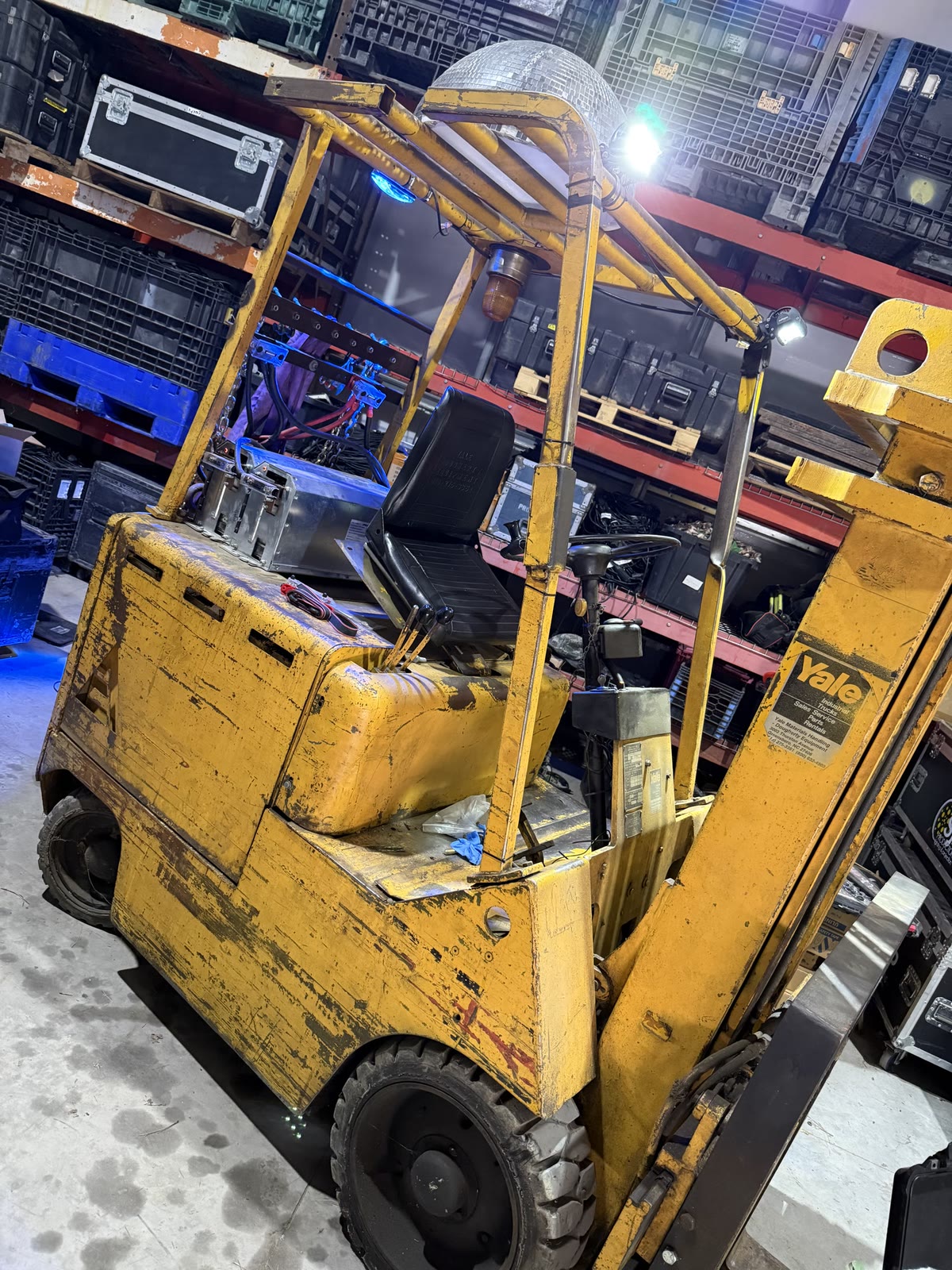
The forklift
It is an old Yale sit-down counterbalance electric on cushion tires, and it has the paint to prove it. It lives in a production warehouse moving road cases and pallets, which is exactly the duty cycle that kills a flooded lead-acid pack: short heavy pulls, long idle gaps, opportunity charging whenever someone remembers.
It is rated for a 6,000 lb load and the machine itself weighs about 12,000 lb — a ratio worth holding on to, because it is the entire reason the counterweight section below exists. It came out of an auction after years of sitting, and the lead-acid pack in it was dead.
TODO(jeremy):the forklift's model number and year.
Why convert a lead-acid forklift to lithium
The usual case for the swap is maintenance and charging behaviour rather than raw energy: no watering, no equalise cycle, no acid, and a chemistry that does not mind being charged in short opportunistic bursts the way a flooded pack does. Against that sits cost, the fact that you now own a battery that needs a management system, and the counterweight problem further down this page.
TODO(jeremy):which of those actually drove this conversion, and what the alternative was (replacement lead-acid pack, different forklift, nothing).
Building the lithium pack into the original battery box
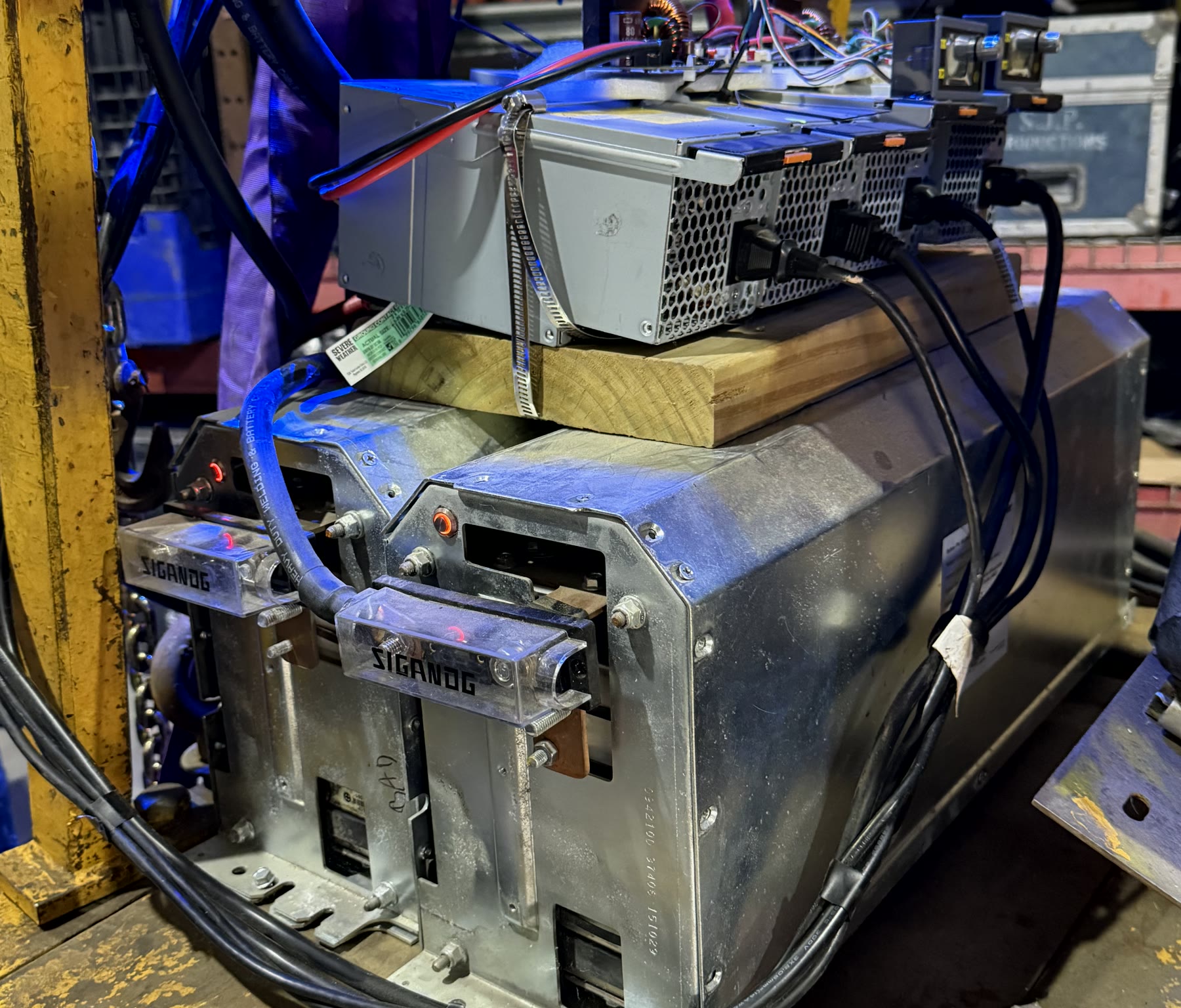
The original steel battery box stayed. On a forklift that is the sensible call: the box is already sized to the compartment, already restrained, already has the rollers and the lifting points, and it keeps the forklift looking stock to anyone who opens the hood. The lithium pack was built inside it.
The cells are SPIM08HP lithium pouches — 3.7 V nominal, 4.2 V full, 8 Ah each, with very low internal resistance and a high continuous discharge rating. That is what a forklift wants: short brutal current pulls rather than a long steady drain. Ten in series gives 37 V nominal and 42 V at full charge, the correct swap for the forklift's 36 V system.
There are two of these packs, wired in parallel, and each one carries its own BMS. That is a deliberate choice rather than one large pack: two independent BMS units mean either half can be isolated, and nothing is trusting a single board with the whole bank.
TODO(jeremy):how many cells in parallel per pack, and the resulting amp-hours and kWh per pack.
TODO(jeremy):how the cells are compressed and restrained, and where the two packs physically sit — the original lead-acid pack stayed in the compartment as ballast, so this needs saying plainly.
Fusing and cable
There are two bolt-down fuse holders on the front face of the box, clear covers on, each with a blown-fuse indicator LED — one per pack. Each pack goes through its own fuse and then into a bulkhead, and it is at that bulkhead that the two packs come together in parallel. Nothing is paralleled ahead of a fuse.
That ordering matters more than it looks. Fusing each pack individually means a fault in one half cannot be fed by the other half through the parallel link — the healthy pack would happily dump its full current into its neighbour's short otherwise. Fusing at the pack rather than only at the machine is the right instinct generally: the shortest possible unprotected run between the cells and the first protective device is the whole game on a battery that can deliver this much current into a dropped wrench.
Each pack also carries its own on/off switch, mounted on the side of the box with a red indicator lamp, so either battery can be shut down on its own without touching the other one. Combined with a BMS per pack, that means each half can be isolated three ways: switched off, fused, or cut by its own BMS.
The cable is printed heavy-duty welding and battery cable, which is the usual choice for this: fine strand count, tolerant of vibration and repeated flex, easy to lug.
TODO(jeremy):fuse ratings and interrupt ratings, cable gauge, and how the lugs were terminated.
Charging the pack
The supply side is four 12 V, 100 A power supplies stacked in series to make roughly 48 V at 100 A. They are not bought parts. They came out of IBM System Storage racks that Battery Hookup donated to the project — the same racks that got gutted to build the shelving for the house battery modules and the housings for the inverters. The supplies were simply still in them. Nothing here was purchased new to be a charger.
Series-stacking supplies is the part worth explaining, because it is where this goes wrong for people. A supply whose output negative is bonded to earth ground cannot be stacked — tie its output to the one below it and that bond becomes a short across the stack. So the ground was lifted on all of them but one, leaving a single earth reference for the whole stack and letting the other three float up on top of it. Four 12 V outputs in series, one reference, 48 V out.
That 48 V stack feeds the charging, and the pack is brought up to roughly 41 V. That is 4.1 V per cell across the 10 in series, and it is deliberately short of the 4.2 V these cells will actually take. The last tenth of a volt per cell buys very little usable capacity and costs cycle life, so the pack simply does not get charged to full. On a machine that only needs an hour of runtime a day, there is no reason to.
The headroom between the 48 V source and the 41 V target is what the charge stage in front of it is there to manage.
TODO(jeremy):which chargers sit between the 48 V stack and the pack, and how charge is terminated — by the charger, by the BMS, or by hand at 41 V. Also whether the original forklift charger plays any part, and whether the hardware in the photo is the finished install or still a bench setup.
TODO(jeremy):the IBM System Storage model the supplies came out of, if it is on the label — it is the kind of detail someone searching for the same surplus part will land on.
The counterweight problem: lithium is lighter than the lead it replaces
This is the part that separates a forklift conversion from every other lithium swap, and it gets skipped in most write-ups. On an electric counterbalance forklift the battery is not just the fuel tank — it is structural ballast. The manufacturer's rated capacity assumes a minimum battery weight sitting in that compartment. Swap in a lithium pack with the same energy and you can drop a large fraction of that mass, which moves the centre of gravity and eats into the forklift's stability margin. The data plate no longer describes the machine you are standing next to.
Conversions deal with this by adding ballast back, by derating what the forklift is used for, or, less responsibly, by ignoring it.
This forklift took the first option, in the simplest form available: the original lead-acid pack was never removed. It was dead, it was never going to hold a charge again, and it was already sitting exactly where the factory wanted that mass. So it stayed in the forklift as ballast and the lithium was added around it. The cells that used to be the fuel tank are now purely structural.
It is an unglamorous answer and it is the right one. A 6,000 lb rated forklift that weighs 12,000 lb is only rated for 6,000 lb with that weight in it. Pull a few hundred pounds of lead out to save weight and the data plate on the cowl is describing a machine that no longer exists.
TODO(jeremy):the weight of the original lead-acid pack, if it is known — it makes the point concrete.
Monitoring the pack over Bluetooth with MultiBMS
A lead-acid forklift tells you almost nothing: a discharge gauge and a hydrometer. A lithium pack with a Bluetooth BMS tells you everything, but only if something is listening. That is why MultiBMS exists — this forklift was one of the packs it was written against.
What the app reads from the pack: voltage, current and power, state of charge, per-cell voltages and temperatures. Sessions can be recorded and replayed afterwards, which on a machine like this is more useful than it sounds — a forklift barely moves, but the trace of what the pack does during a hard lift, and how far the weakest cell drifts from the pack while that happens, is the thing you actually want to see. The Apple Watch app puts the same live numbers on your wrist while your hands are on the controls.
Each pack's BMS is mounted inside the battery box with the cells it watches, so there is no run of sense wire leaving the enclosure. Because this bank is two packs with two separate BMS units, both are connected in MultiBMS at the same time and read side by side on one screen — pack against pack, not one pack at a time. That is the case the multi-pack view was built for, and this forklift is where it came from.
Nothing leaves the phone. There is no account and no subscription, and it works with no signal in the back of a warehouse.
Both packs run a JBD / Xiaoxiang BMS, which is one of only two BMS families MultiBMS has confirmed against real hardware rather than against captured frames — see the compatibility page for what that distinction means and where every other protocol stands. This forklift is part of why that family is marked tested.
TODO(jeremy):the exact JBD model off the label, and its current rating.
TODO(jeremy):a real observation from the app on this forklift: cell drift under load, worst pack sag during a lift, temperature after a hard afternoon. One concrete number beats a paragraph.
Still open
- TODO(jeremy):what would be done differently next time.
- TODO(jeremy):anything that has failed, been re-done, or is still on the list since the conversion.
- TODO(jeremy):total cost, if it is worth publishing.
Specifications
| Item | Detail |
|---|---|
| Machine | Yale electric forklift, sit-down counterbalance. 6,000 lb rated load capacity; roughly 12,000 lb machine weight. Bought at auction after sitting for years TODO(jeremy):model number and year |
| Original battery | Flooded lead-acid traction pack, completely dead on purchase. Left in the forklift on purpose, as ballast TODO(jeremy):system voltage and amp-hour rating |
| Cell chemistry and format | SPIM08HP lithium pouch cells, 3.7 V nominal / 4.2 V full, 8 Ah each TODO(jeremy):total cell count |
| Pack configuration | 10S per pack — 37 V nominal, 42 V full charge. Two packs wired in parallel, each with its own BMS TODO(jeremy):cells in parallel per pack |
| Usable capacity | About one hour of real warehouse work per charge TODO(jeremy):amp-hours and kWh |
| BMS | JBD / Xiaoxiang, one per pack, mounted inside the battery box. JBD is one of the two BMS families MultiBMS has confirmed against real hardware TODO(jeremy):exact JBD model off the label |
| Main fusing | One bolt-down fuse per pack, blown-fuse indicator on each, mounted on the box face. Each pack fuses before it reaches the bulkhead where the two parallel TODO(jeremy):fuse ratings and interrupt rating |
| Cable | Heavy-duty welding and battery cable TODO(jeremy):gauge and lug/crimp method |
| Charging | Four 12 V / 100 A supplies salvaged from IBM System Storage racks (donated by Battery Hookup), series-stacked to 48 V / 100 A with the ground lifted on all but one. Pack charged to about 41 V — 4.1 V per cell, deliberately short of the 4.2 V the cells allow TODO(jeremy):which chargers sit between the stack and the pack, and how charge is terminated |
| Disconnects | On/off switch per pack with a red indicator lamp, mounted on the side of the box, so either battery can be isolated on its own |
| Contactor and precharge | TODO(jeremy):whether the original contactor was kept, and the precharge arrangement |
| Ballast | The original dead lead-acid pack was left in the forklift as counterweight |
| Enclosure | Original steel forklift battery box, retained TODO(jeremy):where the lithium packs physically sit, given the original lead-acid pack stayed in the compartment as ballast |
| Monitoring | MultiBMS on iPhone and Apple Watch, over Bluetooth LE — both packs watched at the same time |
A word about copying this
This is a record of one shop's own conversion, not a how-to. A traction pack of this size will happily vaporise a hand tool, an electric forklift's rated capacity depends on battery weight it no longer has, and none of the numbers on this page transfer to your forklift. Work out your own fusing, your own ballast, and your own charge limits.